Custom Laravel Web Application Development: Building Scalable SaaS, APIs & Business Solutions
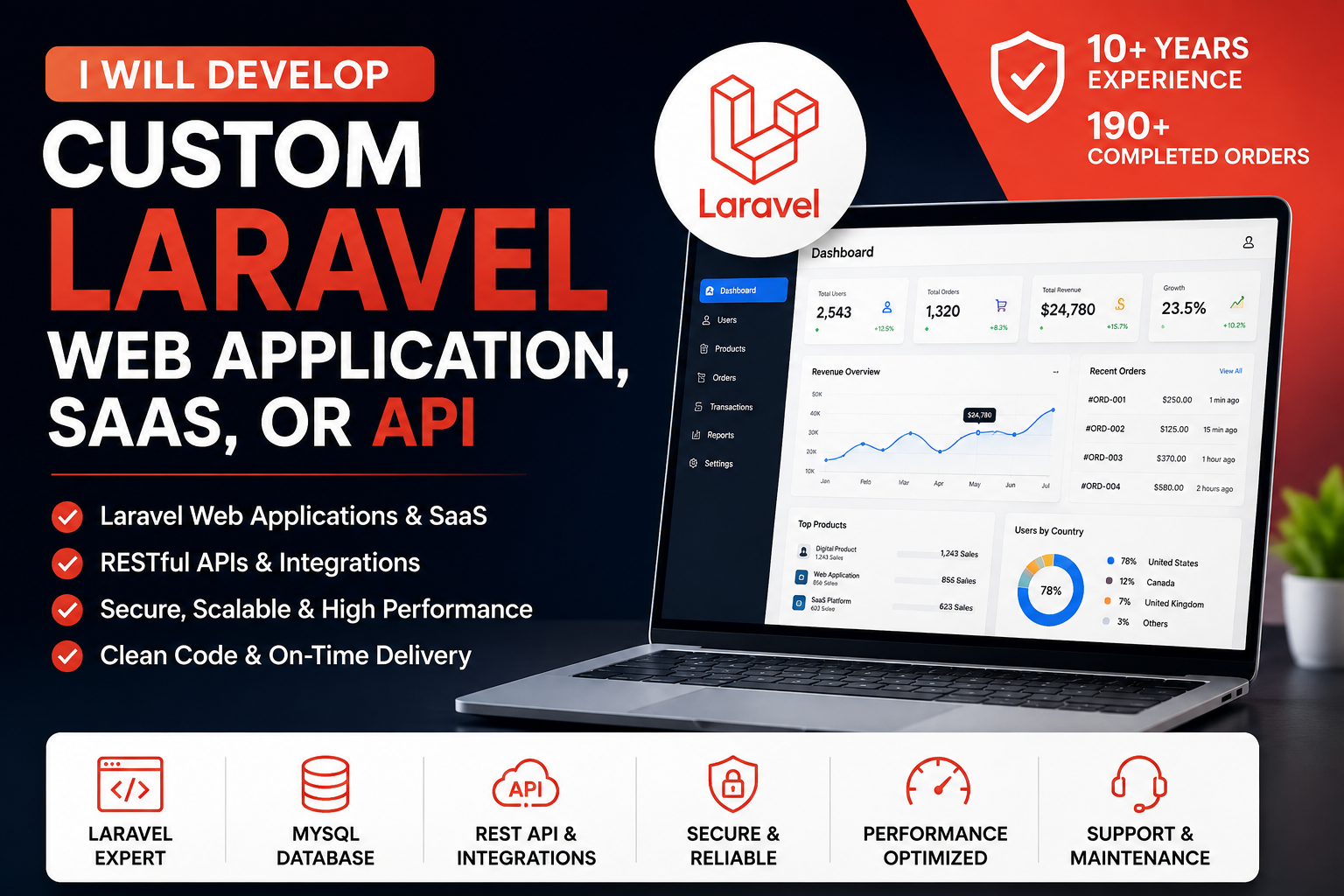
Businesses today need more than just a website. As companies grow, they often need custom software to manage customers, automate processes, integrate external services, and deliver superior digital experiences.
That's where custom Laravel web application development makes a decisive difference.
Laravel is a battle-tested PHP framework that provides engineers with an elegant, highly structured foundation for building modern web applications. From enterprise business management systems and multi-tenant SaaS platforms to high-throughput REST APIs and bespoke admin dashboards, Laravel scales effortlessly to handle ambitious requirements.
With more than 10 years of web development experience and 190+ successfully completed Fiverr orders, I work directly with businesses to transform ideas and complex workflows into reliable, scalable software solutions.
What Is Laravel?
Laravel is a modern PHP framework engineered to simplify complex web application development without sacrificing architectural flexibility.
Instead of writing repetitive boilerplate code from scratch, Laravel provides a comprehensive ecosystem with built-in tools for essential application requirements:
- Authentication & Authorization: Role-based access control (RBAC), multi-guard authentication, and token management via Sanctum or Passport.
- Database Management: Eloquent ORM, zero-downtime database migrations, and expressive schema builders.
- High-Performance Routing & Middleware: Rate limiting, security headers, and route grouping.
- RESTful API Development: Seamless JSON API resources, request validation, and OpenAPI integration.
- Asynchronous Processing: Background jobs, message queues (Redis, SQS), and task scheduling.
- Real-Time Capabilities: WebSockets via Laravel Echo, event broadcasting, and instant notifications.
- File Storage & Cloud Drivers: Uniform APIs for local storage, Amazon S3, and digital asset management.
- Caching & Optimization: Redis, Memcached, and native query caching.
- Automated Testing & Security: PHPUnit/Pest test suites, CSRF protection, SQL injection prevention, and XSS sanitization.
By leveraging Laravel's well-structured ecosystem, businesses achieve faster time-to-market and build codebases that remain straightforward to maintain, extend, and scale as traffic expands.
What Can You Build With Laravel?
Laravel is far more than a simple CMS or content platform. A properly architected Laravel application serves as the operational engine for entire businesses.
1. Custom Web Applications
Every company has unique operational workflows. Off-the-shelf software often forces businesses to compromise, altering their processes to fit rigid software constraints.
A custom Laravel application is tailored precisely around your business logic, automating repetitive bottlenecks and optimizing staff productivity:
- Business Management Systems (ERP)
- Customer Relationship Management (CRM) Platforms
- Custom Project Management & Team Workspaces
- Inventory Tracking & Supply Chain Portals
- Appointment & Service Booking Engines
- Human Resources (HR) & Payroll Systems
- Financial & Invoice Management Dashboards
- Secure Customer & Vendor Portals
2. Software-as-a-Service (SaaS) Platforms
Laravel has become one of the premier choices globally for bootstrapping and scaling SaaS products. Its built-in support for authentication, queues, and subscription billing enables rapid development.
A custom Laravel SaaS architecture typically incorporates:
- Multi-tenant data segregation (single-database or multi-database per tenant).
- Team and organization workspaces with granular permissions.
- Subscription billing, tiered plans, and automated invoicing (Stripe, Lemon Squeezy, PayPal).
- Customer self-service portals and account settings.
- Usage tracking, quotas, and feature gating.
- Comprehensive internal admin analytics.
Architecture Tip: For SaaS platforms, designing the database schema and background queue workers early is critical to prevent performance degradation as active tenants scale.
3. High-Performance REST API Development
Modern digital products rarely operate in silos. A Laravel backend often serves as the core API hub powering a multi-platform ecosystem:
- Native iOS and Android mobile applications.
- Modern Single-Page Applications (React, Next.js, Vue).
- Payment gateways and accounting software (QuickBooks, Xero).
- CRM and marketing automation platforms (HubSpot, Salesforce, Mailchimp).
- Microservices and external partner APIs.
namespace App\Http\Controllers\Api\V1;

use App\Http\Controllers\Controller;
use App\Http\Requests\CreateOrderRequest;
use App\Http\Resources\OrderResource;
use App\Services\OrderProcessingService;
use Illuminate\Http\JsonResponse;

class OrderController extends Controller
{
    public function __construct(
        protected OrderProcessingService $orderService
    ) {}

    public function store(CreateOrderRequest $request): JsonResponse
    {
        $order = $this->orderService->process(
            userId: $request->user()->id,
            orderData: $request->validated()
        );

        return (new OrderResource($order))
            ->response()
            ->setStatusCode(201);
    }
}
By adhering to strict REST standards, request validation classes, and API resource transformers, Laravel ensures your data contracts remain stable, predictable, and secure.
4. Bespoke Admin Dashboards
Operational clarity drives smarter decisions. A custom Laravel dashboard gives stakeholders real-time visibility into their key metrics:
- Unified user and subscriber management.
- Live order and revenue analytics.
- Transaction histories with export capabilities (CSV, PDF, Excel).
- Audit trails, role permission editors, and system health monitors.
5. Third-Party API Integrations
Manual data entry drains time and introduces human error. Laravel applications can seamlessly interface with external platforms to automate data synchronization:
- Payment Gateways: Stripe, PayPal, Razorpay, Authorize.Net.
- Communication Services: Twilio (SMS/WhatsApp), SendGrid, Mailgun, Postmark.
- Shipping & Logistics: FedEx, UPS, DHL, ShipStation.
- Cloud Storage: AWS S3, Google Cloud Storage, Cloudflare R2.
Why Choose Laravel for Your Project?
Clean, Maintainable Architecture (MVC)
Laravel enforces the Model-View-Controller pattern alongside Service layers and Repositories. When built correctly, the code remains modular, making feature additions painless and developer onboarding frictionless.
Scalability from MVP to Enterprise
Scalability doesn't happen by accident—it is the direct outcome of disciplined engineering. Laravel provides the native tools required for high concurrency:
- Redis queue workers for offloading slow tasks (emails, PDF generation, data processing).
- Database read/write connection splitting to optimize read-heavy loads.
- Horizontal scaling across load-balanced cloud servers with centralized sessions.
Laravel + Modern Frontend Combinations
Laravel acts as a powerhouse backend while decoupling seamlessly from modern frontend frameworks:
[ Laravel Backend & Business Logic ]
                  ↓
       [ Secure REST API / JSON ]
                  ↓
[ Next.js / React / Vue Frontend Experience ]
Whether using Next.js/React for ultra-fast server-rendered user interfaces or Inertia.js for monolithic single-page agility, Laravel delivers exceptional developer ergonomics and user satisfaction.
Building from Scratch vs. Modernizing Existing Codebases
Not every business requires a greenfield project. Often, companies already operate a legacy Laravel application that needs revitalization:
- Troubleshooting & Bug Fixes: Resolving intermittent errors, database lockups, or broken integrations.
- Version Upgrades: Transitioning older applications (Laravel 6, 7, 8, 9) to the latest stable Laravel release for security and performance benefits.
- Query Optimization: Eliminating N+1 database queries, adding composite indexes, and speeding up sluggish pages.
- Payment & API Enhancements: Upgrading to modern payment intents, SCA compliance, or new third-party APIs.
- Cloud Deployment & CI/CD: Migrating servers to AWS, DigitalOcean, Forge, or Dockerized infrastructure with zero-downtime deployments.
Before changing a single line of code in an existing system, I audit the codebase to preserve business logic integrity while introducing modern engineering standards.
My 5-Step Approach to Laravel Development
To ensure every project delivers tangible business value, I follow a proven engineering framework:
- Understand Business Requirements: Clarify objectives, user personas, and target outcomes before jumping into implementation.
- Architect the Foundation: Plan database schemas, relationships, caching layers, and external service contracts.
- Modular Development: Build in cohesive, testable components using industry best practices.
- Comprehensive Quality Assurance: Validate user flows, security edge cases, and API responses across different scenarios.
- Built for Long-Term Maintainability: Deliver documented, readable code designed for future scaling.
Ready to Build Your Custom Laravel Solution?
Whether you are launching an innovative SaaS startup, designing a high-volume REST API, or need to stabilize and upgrade an existing Laravel codebase, having an experienced partner is key to avoiding costly architectural mistakes.
With 10+ years of hands-on full-stack development experience and 190+ five-star completed Fiverr projects, I help businesses build software that delivers measurable results.
👉 Discuss Your Project on Fiverr
Have questions about architecture, scoping, or technical feasibility? Let's connect and design the ideal solution for your business!