How Much Does It Cost to Build a Custom Web Application in 2026?
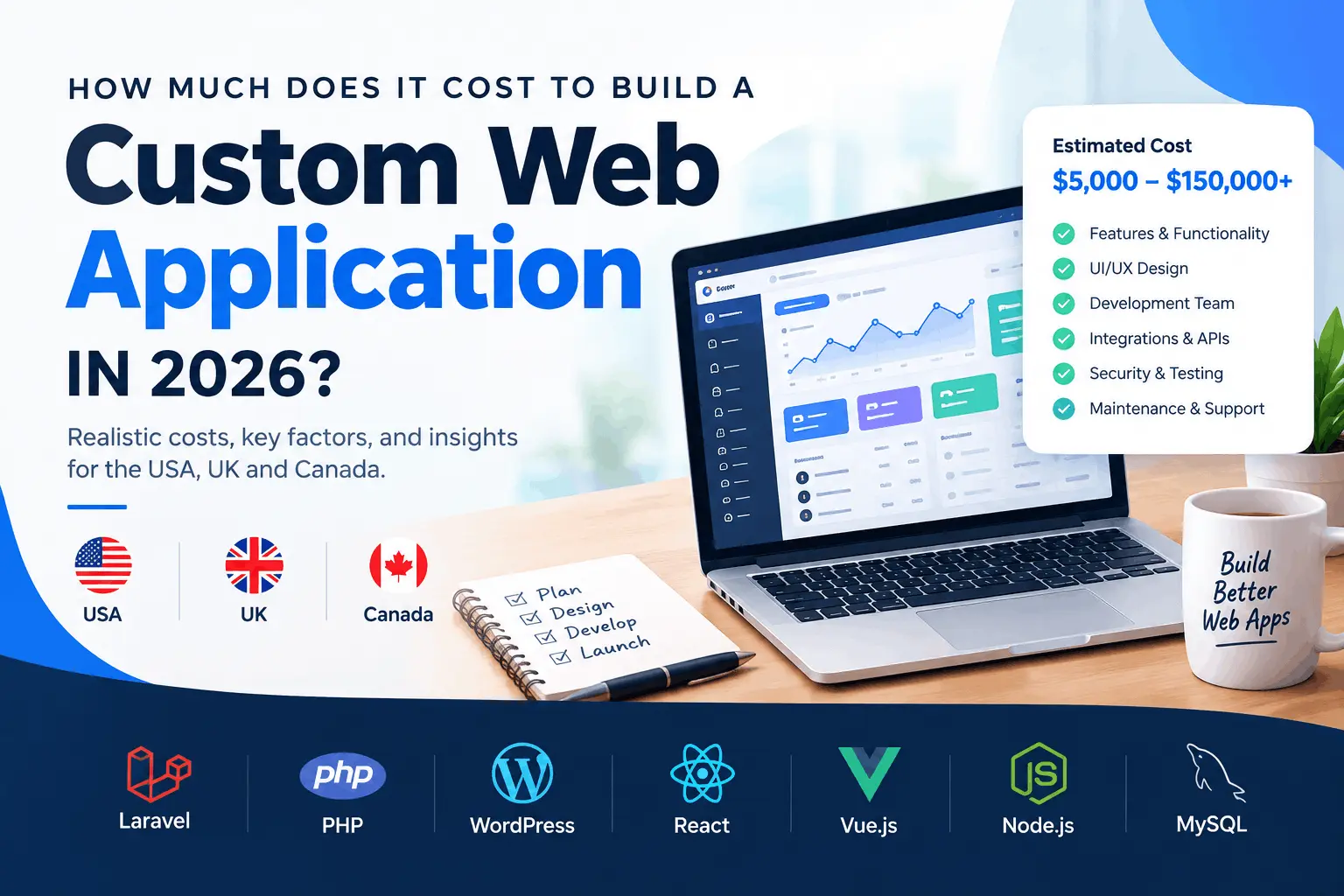
If you're planning to build a custom web application in 2026, one of the first questions you'll probably ask is:
“How much will it cost?”
Unfortunately, there isn't a single flat price that applies to every web application.
A simple internal dashboard can cost a fraction of what a multi-tenant SaaS platform, CRM, marketplace, or customer portal costs. The final budget depends on functionality, third-party integrations, user roles, UI/UX design, security, technology stack, development team structure, and long-term maintenance.
For businesses in the USA, UK, and Canada, custom web application projects can range from several thousand dollars for a focused MVP to well over $100,000 for complex production platforms. Current 2026 industry estimates show substantial variation because different providers include very different levels of design, development, testing, infrastructure, and support.
In this guide, I'll break down the major cost factors so you can estimate a realistic budget before starting your project.
What Is a Custom Web Application?
A custom web application is software that runs through a web browser and is engineered specifically around unique business requirements.
Unlike a typical business website, a web application allows users to log in, create and manage data, perform actions, interact with multi-step workflows, and utilize business-specific functionality.
Common examples include:
- Customer portals
- CRM systems (Customer Relationship Management)
- ERP systems (Enterprise Resource Planning)
- SaaS platforms (Software-as-a-Service)
- Booking & reservation engines
- Learning management systems (LMS)
- Inventory & supply chain management tools
- Project management platforms
- Interactive business dashboards
- Membership & subscription platforms
- Two-sided marketplaces
- Internal business process applications
- REST API-powered applications
A marketing website might mainly present information. A web application actually does something.
That difference has a major impact on development cost.
How Much Does a Custom Web Application Cost in 2026?
Here is a practical starting point for budgeting across different application categories:
- Simple Web Application / MVP: $3,000 – $10,000+
- Custom Business Application: $8,000 – $25,000+
- Customer Portal / Business Dashboard: $15,000 – $40,000+
- SaaS Minimum Viable Product (MVP): $20,000 – $60,000+
- Complex Multi-Tenant SaaS Platform: $50,000 – $150,000+
- Enterprise-Grade Application: $100,000+
These aren't rigid fixed market prices. Current 2026 estimates vary considerably depending on whether you're hiring an individual developer, an offshore team, a boutique studio, or a US/Canadian/UK agency, and what the quoted project actually includes.
For example, published 2026 estimates range from roughly $3,000–$15,000 for scoped MVPs to $50,000–$500,000+ for enterprise-grade, high-concurrency production applications.
The key takeaway is that you should compare scope and quality, not just the headline price tag.
Regional Cost Benchmarks: USA, UK, and Canada
Development rates fluctuate significantly based on geographic location and vendor setup:
Custom Web Application Cost in the USA
The United States generally has some of the highest software development agency rates in the world. A US-based agency may quote substantially more than an experienced independent developer or specialized engineering partner for the same broad functionality.
- Focused application / MVP: $20,000 – $50,000
- Medium business application (multiple user roles, payments, integrations, and reporting): $50,000 – $120,000+
- Complex SaaS and enterprise platforms: $120,000 – $250,000+
Some 2026 US-focused industry benchmarks place production custom web applications in the $25,000–$120,000 range before transitioning into platform-grade projects above $120,000. The goal is not simply finding the cheapest developer—you need to understand what you're actually getting in terms of architecture and maintainability.
Custom Web Application Cost in the UK
UK development costs also show wide variance depending on whether you're working with a freelance specialist, a small agency, or a major central-London consultancy.
- Small-to-medium custom application: £12,000 – £64,000
- Sophisticated web platforms & enterprise portals: £65,000 – £150,000+
One 2026 pricing analysis places small-to-mid custom software projects in the UK around £12,000–£64,000, depending on scope, compliance, and integration complexity. London-based agencies tend to command significantly higher rates than regional firms or independent specialists.
Custom Web Application Cost in Canada
Canadian development pricing follows a similar pattern, reflecting skilled North American engineering standards:
- Simple internal tool: CA$10,000 – CA$25,000
- Customer portal or business dashboard: CA$25,000 – CA$60,000
- SaaS MVP: CA$50,000 – CA$120,000+
- Complex enterprise applications: CA$100,000 – CA$250,000+
Current Canadian 2026 estimates show how drastically clear scope definition alters the final budget.
Why Do Web Application Prices Vary So Much?
Two developers can receive the exact same project description and provide completely different quotes. That's not necessarily because one developer is overcharging.
The variance often stems from:
- Development location & hourly rates
- Developer seniority and technical experience
- Agency overhead and administrative margins
- Depth of UI/UX design and prototyping
- Project management and agile rituals
- Underlying software architecture and database design
- Automated and manual testing rigor
- Security standards and compliance requirements
- Complexity of third-party integrations
- Cloud infrastructure setup, CI/CD, and DevOps
- Code documentation and handover quality
- Post-launch maintenance and warranty support
More importantly, the original project description may lack sufficient technical specifications to accurately estimate the real effort involved.
7 Factors That Affect Custom Web Application Cost
1. Number of Features
Feature volume is the most obvious driver of cost.
- A basic application might only need: user authentication, basic profiles, a simple dashboard, standard CRUD operations (Create, Read, Update, Delete), and basic data tables.
- A modern commercial application often requires: role-based access control, recurring subscription billing, email/push notifications, advanced filtering and search, export capabilities (PDF/CSV), workflow automations, secure file storage, REST APIs, webhooks, audit logs, and multi-tenant isolation.
Every additional feature compounds development time, test coverage, and ongoing maintenance.
2. User Roles and Permissions
An application with a single user type is straightforward. But enterprise software rarely has just one role. Real applications often require distinct permissions for:
- Super Admin
- Branch / Company Manager
- Staff / Employee
- Customer / Client
- Vendor / Partner
- Instructor / Student
Each role requires custom navigation, access rights, tailored dashboards, specific data visibility rules, workflow validations, and personalized email notifications. Implementing granular Role-Based Access Control (RBAC) adds significant structural depth.
3. Third-Party API Integrations
Modern web apps connect to multiple external services. Examples include:
- Payment processors: Stripe, PayPal, Authorize.net
- CRM & marketing: HubSpot, Salesforce, ActiveCampaign
- Accounting & ERP: QuickBooks Online, Xero
- Identity & Cloud: Google Workspace, Microsoft Graph, AWS S3
- Communication: SendGrid, Mailgun, Twilio (SMS / WhatsApp)
- Shipping & Logistics: FedEx, UPS, EasyPost
A clean, modern REST API with thorough documentation is relatively fast to implement. However, legacy systems with dated SOAP protocols, poor documentation, or rigid authentication handshakes can dramatically extend development timelines.
4. UI/UX Design
Do you already have ready-to-code Figma or Adobe XD wireframes?
- If yes: Development can begin immediately against a finalized visual blueprint, reducing discovery time and revision cycles.
- If no: The project will require UX research, wireframing, clickable prototypes, visual styling, responsive design adaptations, and design system tokens.
High-quality UI/UX design can easily represent 20% to 35% of the initial project budget—and it is crucial for user adoption.
5. Database Architecture and Business Logic
A simple CRUD application might only need 5 to 10 relational tables. A complex business platform can involve:
- Dozens of interconnected database tables
- Polymorphic and many-to-many relationships
- Financial calculations and currency conversions
- Inventory reconciliation and lock mechanisms
- Subscription state machines and grace periods
- Comprehensive audit trails and history logging
- High-volume data queries requiring indexing and caching
The more intricate your business rules, the more architectural planning and unit testing are required to ensure data integrity.
6. Security Requirements
Security is non-negotiable. Compromised data can destroy a business reputation overnight. Production applications demand:
- Secure session management and password hashing (Argon2/Bcrypt)
- Two-Factor Authentication (2FA / TOTP)
- Protection against OWASP Top 10 vulnerabilities (CSRF, SQL Injection, XSS)
- API rate limiting and token revocation
- Data encryption at rest and in transit
- Secure file upload validation and sanitization
- Automated database backups with offsite storage
Applications handling healthcare, personal financial data, or European user data (HIPAA, PCI-DSS, GDPR) require dedicated compliance engineering.
7. Testing and Deployment
Development isn't finished simply because the code runs on a local computer. A production-ready release demands:
- Unit and functional testing
- REST API integration tests
- Cross-browser and responsive device testing
- Database migration stress tests
- Cloud server provisioning (AWS, DigitalOcean, Hetzner, VPS)
- Nginx / Apache configuration, SSL certificates, and firewall setup
- Automated CI/CD deployment pipelines
- Application performance monitoring and error logging (Sentry, New Relic)
Cutting corners on testing and deployment is the number one reason "budget" development projects turn into expensive rewrites later.
Freelancer vs. Agency: Which Is More Affordable?
If you are based in the USA, UK, Canada, or Australia, hiring an experienced independent developer is often a significantly more cost-effective choice than a local agency.
An agency maintains substantial overhead:
- Dedicated account managers
- Design directors and project managers
- Multiple developer salaries
- Administrative staff and physical office expenses
An experienced independent full-stack developer often fulfills several of these roles directly—communicating with you one-on-one, writing the code, and optimizing the database without inflated agency billables.
However, lower cost must never mean compromised quality. When evaluating developers, balance:
Experience + Portfolio + Direct Communication + Technical Architecture + Clear Scope + Ongoing Support
rather than choosing solely on the lowest hourly rate.
How to Reduce Your Development Cost
You do not need to sacrifice code quality or security to keep your budget under control. Instead, cut unnecessary scope.
Start with a Lean MVP
Instead of launching a monster application with 50 features on day one, focus on your Minimum Viable Product (MVP):
- Secure Authentication
- The Single Core Business Workflow
- An Intuitive Dashboard
- Payment Processing (if commercial)
- Essential Reporting
Launch this focused version to real customers first. Gather actual feedback, validate your assumptions, and reinvest into secondary features based on measurable user demand. This strategy keeps initial capital risk low and accelerates time-to-market.
Real-World Budget Scenarios
To help you visualize, here are three common project scopes:
Example 1 — Internal Business Tool
- Requirements: Staff login, employee directory, custom task dashboard, customer records, basic CSV exports, and admin privileges.
- Estimated Budget: $5,000 – $15,000+
Example 2 — Customer Portal
- Requirements: Customer registration, self-service order tracking, payment processing, transactional email alerts, document repository, and admin panel with API sync.
- Estimated Budget: $15,000 – $40,000+
Example 3 — Multi-Tenant SaaS Platform
- Requirements: Multi-tenant database architecture, self-serve team onboarding, Stripe subscription billing, granular role permissions, custom dashboard widgets, REST API endpoints, and cloud infrastructure setup.
- Estimated Budget: $30,000 – $100,000+
Don't Ask Only "How Much?"
If you approach a software developer and ask only "How much does a web application cost?", you will likely receive a vague range.
To receive an accurate, reliable estimate, prepare answers to these essential questions:
- Core problem: What specific business bottleneck does the application solve?
- User personas: Who are the primary users, and how many distinct user roles exist?
- Feature list: What are the non-negotiable features for Version 1?
- Design assets: Do you have existing Figma wireframes or brand guidelines?
- Integrations: What external software or third-party APIs need to be connected?
- Payments: Will you process one-time transactions or recurring subscriptions?
- APIs: Does the application need to expose REST APIs for mobile apps or partner integrations?
- Maintenance: Do you need ongoing maintenance, security patches, and server management?
The clearer your requirements, the more precise and actionable your quote will be.
What Technology Stack Should You Use?
Technology should be chosen based on your project's longevity, security, and team maintainability—not just whatever trend is popular on social media.
- Backend & Business Logic: Laravel (PHP) + MySQL / PostgreSQL remains one of the most cost-effective and reliable ecosystems for business applications, SaaS platforms, portals, and robust REST APIs. It provides battle-tested security, built-in queue workers, and rapid development speed.
- Modern Interactive Frontend: Pair your backend with React, Vue.js, or Next.js for real-time dashboards, fluid single-page applications, and interactive user flows.
- API Microservices & Real-Time: Node.js and Express.js provide lightweight, event-driven backends when high concurrency and WebSocket communication are required.
The right stack is the one that allows your business to ship fast, scale stably, and maintain the codebase affordably.
How I Approach Custom Web Application Projects
I work with startups, business owners, and growing companies that need solid, tailor-made web applications rather than generic templates.
My hands-on experience includes:
- Laravel Applications & SaaS Platforms
- Full-Stack JavaScript (React, Vue.js, Node.js, Express)
- Secure REST API Development & Third-Party Integrations
- Custom WordPress & Bespoke Plugin Engineering
- Relational Database Design & Query Optimization (MySQL / PostgreSQL)
- Existing Codebase Audits, Bug Fixing & Modernization
For every new project, I take the time to understand your business objectives first. We define:
What needs to be built → How it should be architected → How much effort it requires → What belongs in Version 1.0.
Need Help Building Your Web Application?
If you are planning a custom web application and want an experienced developer who writes clean, scalable, maintainable code, let's talk.
I specialize in Laravel, PHP, React, Vue.js, Node.js, MySQL, and REST API development.
Ready to discuss your project?
👉 View My Custom Web Application Development Gig on Fiverr
Or explore my profile and reviews: Russel Hussain on Fiverr
Whether you are based in the USA, UK, Canada, or anywhere globally, you can send me your project requirements and we can review your scope, choose the right architecture, and plan a realistic budget before writing a single line of code.
Final Thoughts
There is no universal, one-size-fits-all price for custom web application development in 2026. A focused MVP can be built for several thousand dollars, while an expansive enterprise SaaS application can demand tens or hundreds of thousands of dollars.
The final budget always comes down to:
Scope + Technical Complexity + Integrations + User Roles + UI/UX Design + Security + Engineering Quality + Ongoing Support.
Instead of asking:
“What is the cheapest developer I can find?”
Ask yourself:
“What is the smallest, most reliable version of this application I can build to validate my idea and solve the business problem?”
Answering that single question will save you thousands of dollars while laying a rock-solid foundation for future growth.