When Should Your Business Choose WordPress vs Custom Web Development?
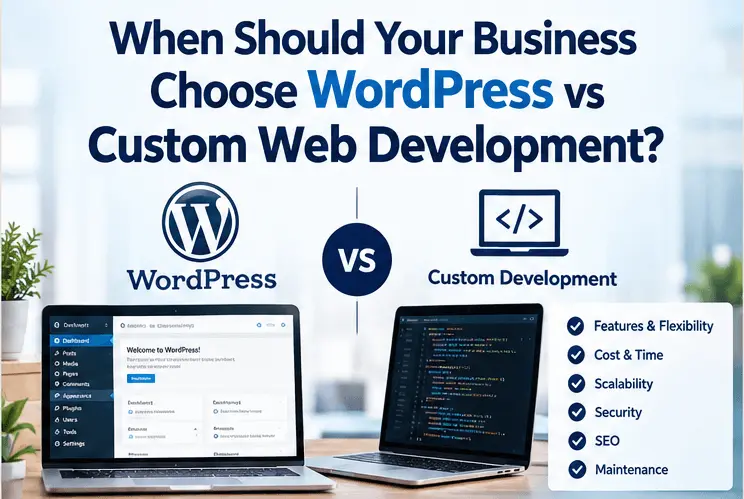
If you're starting a new business website, one of the first technology decisions you'll face is:
Should we use WordPress, or should we build a custom web application?
For businesses in the USA, UK, Canada, Germany, Australia, and other international markets, both approaches can be excellent choices. The right option depends on what you're trying to accomplish, how quickly you need to launch, your budget, the functionality you need, and how much control you expect over the application in the future.
WordPress is far more than a simple blogging platform. As of September 2026, WordPress is used by about 40.2% of all websites, representing 58.8% of websites whose content management system is known, according to W3Techs.
At the same time, there are situations where WordPress isn't the ideal foundation. If your business needs highly specialized workflows, complex business logic, advanced integrations, or a completely custom software platform, building a dedicated application can make more sense.
So, when should you choose WordPress, and when should you invest in custom web development?
Let's break it down.
WordPress vs Custom Web Development at a Glance
| Requirement | WordPress | Custom Web Development |
|---|---|---|
| Business website | Excellent fit | Possible, but may be unnecessary |
| Blog/content publishing | Excellent fit | Requires custom CMS |
| Marketing website | Excellent fit | Excellent |
| Company website | Excellent fit | Possible |
| Landing pages | Excellent fit | Possible |
| Basic e-commerce | Excellent fit with WooCommerce | Excellent |
| Membership website | Good fit | Excellent for complex requirements |
| Custom SaaS | Possible | Strong fit |
| Complex business workflows | Can be customized | Strong fit |
| Complex CRM/ERP | Usually requires extensive customization | Strong fit |
| Highly specialized application | May become difficult | Strong fit |
| Custom APIs | Possible | Strong fit |
| Real-time application | Possible with additional architecture | Strong fit |
| Initial development cost | Often lower | Usually higher |
| Time to launch | Often faster | Usually longer |
| Long-term customization | Good with development | Very high |
| Maintenance | Updates/plugins/themes required | Fully controlled by development team |
The important thing is that WordPress isn't automatically better because it is cheaper, and custom development isn't automatically better because it is more sophisticated.
The technology should match the business problem.
What Is WordPress?
WordPress is an open-source content management system (CMS) that allows businesses to create, manage, and publish website content easily and reliably.
A WordPress website can include:
- Pages
- Blog posts
- Images and multimedia
- Videos
- Contact forms
- Products
- Services
- User accounts
- Memberships
- Custom content types
- E-commerce
- APIs
- Custom functionality
WordPress also features an extensive ecosystem of themes and plugins. Its developer ecosystem supports both modern block themes (Full Site Editing) and classic themes, while plugins can extend WordPress functionality without modifying WordPress core.
That makes WordPress particularly useful when a business needs a professional website that its marketing and operations teams can continue managing independently after development.
What Is Custom Web Development?
Custom web development means building an application specifically engineered around your unique business requirements instead of relying primarily on a pre-built CMS.
A custom application might use modern technologies such as:
- Backend: Laravel, PHP, Node.js, Express.js, NestJS, Python
- Frontend: React, Vue.js, Next.js, Nuxt, Tailwind CSS
- Databases: MySQL, PostgreSQL, MongoDB, Redis
- Architecture: REST APIs, GraphQL, Microservices, WebSockets
For example, imagine a company needs a platform where:
- Customers register accounts.
- Companies create organizations.
- Employees are invited.
- Different users receive different granular permissions.
- Customers subscribe to tiered billing plans.
- Payments are processed automatically through Stripe or PayPal.
- Usage is tracked and metered in real-time.
- Reports and analytics are generated.
- External enterprise systems are integrated.
- Administrators manage everything from a bespoke dashboard.
At this point, you're no longer simply building a company website.
You're building a business application.
That's where custom development becomes increasingly relevant and necessary.
When Should Your Business Choose WordPress?
There are many situations where WordPress is not just adequate, but an outstanding choice.
1. You Need a Professional Business Website
If your primary requirement is a website that showcases your brand, explains your business, outlines your services, displays your products, and collects inbound leads, WordPress is an extremely practical solution.
For example:
- Consulting companies
- Law firms
- Restaurants and cafes
- Hotels and hospitality
- Marketing and creative agencies
- Construction companies
- Real estate businesses
- Healthcare organizations and private clinics
- Education and training companies
- Professional service providers
- Local businesses
- Seed-stage startups
A typical business website might include:
- Home
- About Us
- Services
- Portfolio / Case Studies
- Blog / News
- Testimonials / Reviews
- Contact Us
- FAQ
There is usually little business justification to build a custom CMS from scratch for this type of website.
2. You Need to Publish Content Regularly
If inbound content marketing, SEO blogging, and resource guides are central to your organic growth strategy, WordPress has few equals.
Your marketing team can independently manage:
- Blog posts and articles
- Landing pages
- Categories and tags
- Featured media and video embeds
- Author profiles
- SEO metadata and schema
- Navigation menus and footers
All of this happens through an intuitive user interface without requiring a developer's time for every headline tweak or article update.
3. You Need to Launch Quickly
Businesses often operate under tight market timelines and want to launch a website within a few weeks rather than waiting several months for custom software development.
WordPress drastically shortens time-to-market because core foundational features already exist out of the box:
- User authentication and role management
- Media libraries and image processing
- Content drafting, previewing, and scheduling
- SEO and slug management
- Built-in commenting and form processing
Instead of reinventing wheels, developers can focus on customizing themes, blocks, templates, styling, and specific integrations.
4. You Have a Limited Initial Budget
Custom software development requires designing system architecture, database schemas, API contracts, frontend interfaces, authentication flows, authorization logic, automated test suites, deployment pipelines, and custom administration panels.
If your objective is simply a credible, high-converting digital storefront or business website, investing tens of thousands of dollars into custom software rarely produces an equivalent return on investment.
WordPress provides an economical, robust starting point that conserves capital for marketing and product development.
5. You Want Your Team to Manage the Website
Non-technical teams often struggle with custom software unless a polished administrative UI has been built for every conceivable operation.
With WordPress, marketing and editorial teams can:
- Publish and update articles
- Modify service offerings
- Upload photos and case study graphics
- Edit copy and call-to-action banners
- Build new promotional landing pages
- Adjust navigation menus
- Update product listings and prices
The native editor empowers non-developers to keep the website active and up-to-date without recurring engineering tickets.
6. You Need E-Commerce
WordPress can be transformed into a scalable e-commerce store with solutions like WooCommerce.
With WooCommerce, businesses can easily support:
- Physical and digital product catalogs
- Shopping carts and customizable checkouts
- Customer account portals
- Order processing and automated notifications
- Secure payment gateways (Stripe, PayPal, Apple Pay, etc.)
- Discount codes and promotion management
- Shipping rules and tax calculation
- Inventory and stock tracking
For standard e-commerce shops, WordPress combined with an established ecosystem is a proven, reliable solution. However, when complex multi-vendor workflows or bespoke algorithmic pricing enter the picture, custom development may eventually be warranted.
When Should You Consider Custom Web Development?
WordPress is undeniably versatile, but versatility does not mean it is the correct architectural choice for every use case.
Here are scenarios where custom web development is the right path forward:
1. Your Business Has Complex Workflows
Consider a corporate business platform requiring:
- Multi-tier department approvals
- Complex organizational hierarchies
- Dynamic approval chains
- Automated background jobs and webhooks
- Advanced custom calculation engines
- Custom audit logs and compliance reporting
- Strict proprietary business rules
While you can write plugins to force WordPress to handle these requirements, you will constantly be fighting CMS conventions. A custom application built on a clean framework like Laravel or Node.js provides a cleaner, maintainable architecture.
2. You're Building a SaaS Platform
If you are developing a Software-as-a-Service (SaaS) product where customers:
- Sign up for multi-tenant accounts
- Create company workspaces
- Invite team members with role-based permissions
- Subscribe to monthly or annual recurring plans
- Access real-time analytical dashboards
- Meter API usage against strict rate limits
- Connect third-party webhooks and integrations
- Export custom reports
This is fundamentally different from a content-publishing website. A dedicated architecture utilizing Laravel, Node.js, React, and PostgreSQL offers the exact precision, security, and scalability a SaaS business needs.
3. You Need Highly Specialized Functionality
Certain industries rely on complex data handling that standard plugins cannot reliably satisfy:
- Healthcare and patient management systems
- Hospital and clinic management software
- Fleet tracking and logistics portals
- Financial management and accounting platforms
- Custom Enterprise Resource Planning (ERP) tools
- Learning Management Systems (LMS) with proprietary grading logic
- Project and resource management portals
- Custom Customer Relationship Management (CRM) tools
- Industry-specific two-sided marketplaces
When the core objective of the application is running day-to-day business operations rather than publishing marketing content, custom software engineering becomes the superior choice.
4. You Need a Bespoke User Experience
WordPress can accommodate custom styling, but if the product demands a completely unique, application-like interactive experience:
Customer Login ↓ Interactive Dashboard ↓ Projects ↓ Tasks ↓ Analytics & Reports ↓ Billing ↓ Team Permissions
When every single screen is unique, interactive, and reactive, building a dedicated single-page application (SPA) or Next.js app on top of a tailored backend is significantly cleaner than overriding WordPress templates.
5. You Need Complex Integrations
Modern enterprises require bidirectional data flow across multiple systems:
- Enterprise CRM and ERP platforms (Salesforce, SAP, HubSpot)
- Accounting software (QuickBooks, Xero)
- Payment gateways with split settlements
- Shipping and warehousing APIs
- Internal proprietary microservices
- Artificial Intelligence and machine learning pipelines
- Real-time communication and analytics platforms
- Helpdesk and support desk ticketing
While WordPress has a REST API, when integrations become deep, synchronous, and mission-critical, a custom backend provides complete control over queues, retries, and error handling.
6. Your Application Has Complex Data Relationships
Consider a system modeling:
Organizations ──▶ Users ──▶ Projects ──▶ Tasks ──▶ Invoices ──▶ Payments ──▶ Reports
Add to this:
- Multi-tenancy isolation
- Granular permission matrices
- Tiered feature flags
- Storage and API quotas
- Event sourcing and audit logging
- Asynchronous notification dispatches
WordPress relies on a post/postmeta database schema designed for content. While custom tables can be added, custom development allows you to design normalized relational schemas (or distributed NoSQL collections) optimized specifically for high-throughput queries.
WordPress Doesn't Mean "No Custom Development"
A common misconception is that choosing WordPress means simply installing a off-the-shelf theme, piling on twenty plugins, and calling it a day.
That is not how professional WordPress development works.
Professional WordPress development regularly involves extensive custom engineering:
- Custom Themes: Lightweight, bespoke themes built from scratch with semantic HTML, CSS, and modern JavaScript.
- Custom Plugins: Purpose-built plugins implementing unique business logic cleanly without plugin bloat.
- Custom Post Types & Taxonomies: Custom data structures designed specifically for your content needs.
- Custom Gutenberg Blocks: Modern React-powered blocks for editor flexibility.
- REST API Endpoints: Custom API routes to expose WordPress data to mobile apps or headless frontends.
- Database Integrations: Direct integration with custom MySQL tables for high-performance requirements.
- WooCommerce Extensions: Tailored checkout funnels, custom shipping rules, and payment gateways.
[!NOTE] The official WordPress developer guidelines explicitly recommend extending functionality via custom plugins rather than modifying core files, ensuring updates never overwrite custom business code.
When Do You Need a Custom WordPress Plugin?
Sometimes you don't need to abandon WordPress for a custom application. Instead, you just need to extend WordPress correctly.
A custom plugin is ideal when existing off-the-shelf plugins either don't exist, introduce security risks, or bloat your site:
Custom API Integration
Synchronize inventory, CRM contacts, or lead events directly with your internal systems or external third-party services.
Custom Admin Panels
Give administrators dedicated management screens to oversee proprietary business data without cluttering default post screens.
Custom Interactive Forms
Implement dynamic multi-step forms that perform server-side calculations, external validation, or conditional routing.
WooCommerce Customization
Build custom checkout processes, tiered volume discounts, B2B pricing tiers, custom shipping calculation rules, or local payment integrations.
Custom Content Management
Organize complex business portfolios, vehicle listings, real estate listings, or event schedules using structured custom post types and custom fields.
Automated Processes & Background Tasks
Schedule cron jobs in WordPress to automate data synchronization, daily email summaries, inventory adjustments, and external backups.
WordPress vs Custom Development: Cost Comparison
Cost is frequently the primary factor for business owners, but costs should be evaluated over the entire software lifecycle.
Upfront Development Cost
A typical WordPress business website requires:
- UI/UX design & brand adaptation
- Custom theme development or customization
- Core page builds & content integration
- Form setup & lead routing
- Technical SEO & performance optimization
- Essential security hardening
A custom web application typically requires:
- Full system architecture design
- Relational database modeling
- Backend API development
- Modern frontend component engineering
- Authentication, session handling & authorization roles
- Automated testing (Unit & Feature tests)
- Cloud infrastructure setup, CI/CD, and staging environments
- Ongoing monitoring and logging
Consequently, custom web development requires a larger upfront investment than a standard WordPress website.
Ongoing Lifecycle Cost
However, upfront cost is only part of the equation:
- Maintenance & Updates: WordPress requires ongoing plugin, theme, and core updates, along with regression testing. Custom applications require dependency updates and security patches.
- Hosting & Infrastructure: WordPress runs cost-effectively on standard managed hosting. Custom applications often require dedicated cloud servers, managed databases, and Redis clusters.
- Scalability & Adaptability: If your business model outgrows WordPress and requires continuous hacks to stay functional, retrofitting WordPress can become more expensive than building a custom application from the start.
Regional Considerations: USA, UK, Canada & Germany
For Businesses in the USA
US businesses often prioritize speed-to-market and operational agility. For service businesses, consulting firms, legal practices, and local companies, WordPress delivers immediate credibility at low cost. For venture-backed startups and SaaS concepts, custom Laravel or Node.js backends are standard for rapid scaling.
For Businesses in the UK
UK companies often emphasize clean brand presentation, compliant data capture, and clear user journeys. A local trades or professional service company benefits immensely from WordPress's SEO strengths, while bespoke financial technology or logistics platforms necessitate custom development.
For Businesses in the Canada
Canadian enterprises operate across diverse bilingual markets. WordPress excels with multilingual plugins (like WPML or Polylang) for corporate and institutional sites. When complex member portals or government compliance workflows are required, custom architectures shine.
For Businesses in Germany & Europe
For German and European businesses, privacy (GDPR compliance), data sovereignty, multilingual support, and structured integrations are paramount. WordPress provides strong localized data management with proper hosting. When building proprietary industrial, logistics, or healthcare software, custom engineering offers complete compliance control over every packet of data.
A Simple Decision Framework
Use this checklist to identify which path fits your current business stage:
Choose WordPress if:
- ✅ You need a corporate, agency, or service business website.
- ✅ Content publishing and ongoing SEO blogging are top priorities.
- ✅ You want to launch within 2 to 4 weeks.
- ✅ Your non-technical team needs full day-to-day control over text and images.
- ✅ You need standard e-commerce (online store, digital downloads).
- ✅ You are working with a sensible startup or small-business budget.
- ✅ Existing plugins or targeted custom plugins satisfy your requirements.
Consider Custom Web Development if:
- ✅ You are building a SaaS or subscription product.
- ✅ Your business processes involve complex, multi-step approval workflows.
- ✅ You are building a custom CRM, ERP, or internal operations platform.
- ✅ Your product requires proprietary calculation engines or business logic.
- ✅ You require an interactive, app-like customer portal or custom dashboard.
- ✅ You require extensive, real-time bidirectional API integrations.
- ✅ Your data schema is complex, relational, and requires high concurrency.
- ✅ Most of the features you envision have to be built from scratch.
The Hybrid Approach: WordPress + Custom Development
The decision doesn't have to be binary. Many successful enterprises combine both technologies to leverage their respective strengths:
┌──────────────────────────────────────┐     ┌──────────────────────────────────────┐
│           WordPress CMS              │     │       Custom Web Application         │
│  - Marketing Website                 │     │  - Customer Dashboard (React/Next)   │
│  - Company Blog & SEO Pages          │ ──▶ │  - Proprietary Business Logic        │
│  - Case Studies & Landing Pages      │     │  - Payment & Usage Billing           │
│  - Managed by Marketing Team         │     │  - REST API & Database (Laravel/Node)│
└──────────────────────────────────────┘     └──────────────────────────────────────┘
In this architecture:
- WordPress powers
(marketing, SEO, articles, lead capture).yoursite.com - Custom Application powers
(authenticated customer portal, SaaS engine, reports).app.yoursite.com
Another modern alternative is Headless WordPress, where WordPress acts as a backend content repository via its REST API or GraphQL, while a modern Next.js or React frontend renders the user interface.
Avoiding Common Mistakes
1. Don't Over-Customize WordPress
Avoid forcing WordPress to be an enterprise ERP. Building dozens of custom database tables, background message queues, and intricate multi-tenant permission layers inside WordPress leads to technical debt that is painful to maintain.
2. Don't Over-Engineer a Simple Website
Avoid spending $30,000 building a custom CMS, custom authentication, and custom admin panel just to publish a 10-page company website. If WordPress solves 90% of your actual business requirements out of the box, rebuilding it from scratch is a waste of capital.
Security and Performance Considerations
Security
- WordPress: Security requires active governance: running current PHP versions, keeping core/plugins updated, using two-factor authentication, and choosing reputable extensions.
- Custom Applications: You are responsible for every line of code: SQL injection prevention, cross-site scripting (XSS) mitigations, CSRF protection, secure cookie handling, and access-control validation.
[!IMPORTANT] A custom application is not inherently more secure simply because it is custom. Security in both worlds depends on clean code, secure dependencies, and disciplined infrastructure management.
Performance
A lightweight, well-coded WordPress installation with a fast caching layer and optimized media can achieve 95+ Google PageSpeed scores with ease. Conversely, an unoptimized custom app with N+1 database queries can be just as sluggish as a bloated WordPress site. Performance is an engineering discipline, not a brand name.
What Should a Startup Choose?
For early-stage startups, let your business model dictate your technology:
- Company or Agency Website: Start with WordPress to establish authority quickly.
- Content-Driven or Media Business: WordPress is the clear winner.
- SaaS or Digital Product: Invest directly in a custom stack (Laravel, Node.js, React).
- Online Marketplace: Prototype on WordPress/WooCommerce; migrate to custom code once product-market fit is validated.
- Internal Operations Tool: Custom development prevents workflow compromises.
My Approach to WordPress & Custom Development
As a full-stack software engineer working with both WordPress/PHP and custom stacks (Laravel, React, Node.js), I help businesses choose and build the architecture that fits their goals.
Professional WordPress Website Development
If a WordPress website is the right fit for your business, I build responsive, secure, and search-optimized websites designed to convert visitors into clients:
- Business website development
- Theme customization & Full Site Editing
- Responsive mobile-first design
- Custom landing page layouts
- WooCommerce setup and customization
- Speed optimization and SEO setup
- Bug fixing and legacy site overhaul
View my WordPress Website Development Gig on Fiverr:
👉 I will build or customize a WordPress website for your business
Custom WordPress Plugins & Integrations
When off-the-shelf plugins don't fit your business requirements, I develop custom, lightweight WordPress plugins built strictly to WordPress coding standards:
- Custom WordPress plugin development
- Third-party API integrations (CRMs, payment gateways, ERPs)
- Custom admin management dashboards
- Custom post types, taxonomies & metadata
- WooCommerce custom pricing and checkout logic
- Automated cron tasks and data synchronization
- Plugin performance optimization and bug fixing
View my Custom WordPress Plugin Gig on Fiverr:
Final Thoughts
When should your business choose WordPress vs custom web development?
The answer always comes down to what you are actually building:
- Choose WordPress when you need a content-rich, SEO-friendly, professional website that your team can manage easily without developer dependency.
- Choose Custom Web Development when you are building a proprietary SaaS platform, complex internal tooling, or an application with unique business logic.
- Or combine both to get the best marketing engine and the best application engine simultaneously.
Always follow this sequence:
Business Objectives ──▶ Core Features ──▶ User Workflows ──▶ Integrations ──▶ Budget ──▶ Technology Choice
When your technology stack follows your actual business requirements, you build an asset that scales smoothly and delivers genuine business value.